
How To Find Divorcing Homeowners And List Them
Divorce is one of the most overlooked sources of real estate listings. According to the CDC, over 670,000 divorces were finalized in the U.S. in 2023, and a large share of those involve a home that has to be sold or refinanced. When you know how to find these leads and approach them the right way, you're often the only agent in the conversation.
There are two ways to build a divorce listing business: cultivating referrals from divorce attorneys, or reaching out directly to people who've already filed. This lesson covers the second path.
Success Story:
One of our members built a real system around this. He contacted his local clerk of court, learned how to access divorce filings, cross-referenced those names against property records to confirm real estate ownership, and mailed his book with a personal cover letter. He followed up by phone and mail until he reached people. Out of about 70 contacts, he landed 5 listings. Even better, several of those same sellers came back to buy their next home once the divorce was final, sometimes both spouses separately.
Divorce filings are public record in every state. That part never changes. What changes is how easy those records are to find, and that depends entirely on where you're doing business.
Before you start searching, here's what to expect: you're generally trying to confirm that a divorce case exists and who filed it, not trying to read every page of the file. That's all you need to run this lead source. Some places make that a five-minute search from your computer. Others require a phone call to a courthouse. Neither one is a dead end, they're just different starting points.
Find your state below and start there.
If you work in one of the following states, you're in the best position. Your state runs one search tool that covers the whole state, so you don't need to figure out which county to look in first.
Alabama, Alaska, Arizona, Arkansas, Connecticut, Delaware, Hawaii, Idaho, Indiana, Iowa, Kansas, Kentucky, Maryland, Massachusetts, Minnesota, Missouri, Nebraska, New Jersey, New Mexico, New York, North Carolina, North Dakota, Oklahoma, Oregon, Pennsylvania, Rhode Island, South Carolina, South Dakota, Texas, Utah, Vermont, Virginia, Washington, Wisconsin, Wyoming, West Virginia, and Washington D.C.
How to use it:
- Search "[your state] court records search" or "[your state] case lookup" to find your state's official portal.
- Search by name, not case number. You won't have a case number yet, that's what you're trying to find.
- Narrow by case type if the system lets you: look for "family law" or "domestic relations."
- When you get a match, note the names, the filing date, and the county. That's your starting point.
A few of these systems (Alabama, Kansas, and Utah, for example) sit behind a small subscription fee even though they're statewide. Don't let that stop you, it's usually a minor cost for a real time saver.
Don't expect every one of these systems to hand you the full case file. Most show you the docket, the names, the dates, the status, which is exactly what you need to start reaching out. Reading the entire file isn't necessary for this strategy to work.
One more thing before you search: not every system lets you get a list. Some let you leave the name blank, pick a date range and "family law" as the case type, and it hands you every case filed in that window, which is exactly what you want. Others require you to type in a specific name before anything shows up, meaning date range and case type just narrow down a name search rather than replacing it. There's no way to know which kind you're dealing with until you check. If the search form makes name a required field, that county's portal isn't built for browsing, and you'll need another way in (see the next section).
These states don't have one statewide system. Instead, each county runs its own records search, so what works in one county might not work in the county next door, even in the same state.
California, Colorado, Florida, Georgia, Illinois, Louisiana, Maine, Michigan, Mississippi, Montana, Nevada, New Hampshire, Ohio, and Tennessee.
How to use it:
- Identify the specific county you're working in. This is the step people skip, and it's the one that matters most in these states.
- Search "[county name] clerk of court records search" or "[county name] case lookup."
- If that county has a portal, use it the same way as Group 1: search by name, note the filing date and case status.
- If you can't find anything online for that county, call the clerk's office directly and ask how they handle records requests. This is completely normal in these states, you're not doing anything wrong by having to call.
A couple of things worth knowing if you work Florida or California specifically, since they're two of the biggest markets in this niche:
- Florida doesn't have one statewide system, but most of its counties, including the big ones like Miami-Dade, Broward, and Orange, do have solid online search tools of their own. You're usually in decent shape here.
- California is public record by law, but many counties handle family law cases more cautiously than other case types. Don't be surprised if a county's general search works fine for most cases but family law specifically routes you toward the clerk's office for more detail.
Getting A List vs. Looking Up One Name At A Time
This is the single biggest thing to understand before you start: you want a list of everyone who recently filed for divorce, not a way to check on one name you already have. Not every system gives you that.
Some portals let you browse. Leave the name field blank, set a date range, choose "family law" or "domestic relations" as the case type, and it returns every matching case filed in that window. When you find a system like this, you're set.
Most portals require a name first. Type in a name, and the system searches for it. Date range and case type are just filters on top of that name search, they don't replace it. If a search form marks the name field as required, that portal cannot hand you a list. It can only confirm one specific person you already know about.
There's no way to tell which kind you're dealing with without opening the search page and checking. It varies county by county, even within the same state.
If your local system requires a name and you need volume, a paid legal records aggregator (services like UniCourt are built for exactly this) will let you filter by case type, date range, and location without needing a name, pulling from many courts at once. It costs money, but it solves the exact problem a name-required portal can't.
What You'll Actually Find, And Why That's Enough
Here's something worth knowing before you start: finding a case and reading every document inside it are two different things, and almost everywhere you search, you'll only get the first one online.
Most systems, statewide or county-level, show you the docket: party names, filing date, case type, case status. Very few states let a member of the public pull up and read the full case file online without an account. That's normal, and it's not a problem for this strategy.
Here's why: everything you need to run this system- someone's name, the fact that they filed for divorce, and enough to go verify property ownership separately- comes from the docket alone. You don't need the financial disclosures or the custody terms to send a letter and make a phone call.
If you ever do need something beyond the docket, either because a lead is especially promising or a client asks a specific question, that's when you contact the clerk's office directly. Every county clerk fields this kind of request regularly. Don't overthink it, just call and ask.
Quick Recap
• Divorce records are public everywhere. What varies is how easy they are to find.
• Find your state above. If it's in Group 1, search from home. If it's in Group 2, find your county first.
• Check whether that portal lets you browse by date and case type with no name, or whether it requires a name to search at all. This matters more than which tier your state falls into.
• If your local portal requires a name and you need a real list, a paid legal-records aggregator can search by case type and date across many courts without needing a name.
• If nothing online works, call the clerk. That's a completely normal step, not a dead end.
• You only need the docket, names, filing date, and case status to run this strategy. You don't need to read the full case file.
Things change. Counties upgrade their systems, states roll out new portals. If something in this guide doesn't match what you're finding in your area, that's worth flagging so it can get updated for everyone else too.
Cross-reference the names you find against your county's property appraiser or tax assessor site. If that's not available online in your area, a paid records service can fill the gap. This step matters because plenty of people going through a divorce don't own a home, and you want to spend your time on the ones who do.
Once you've confirmed ownership, property records will usually give you a mailing address. For phone numbers, a paid skip-tracing service is typically your fastest route, or you can piece it together manually through public search. Get everything into your CRM or spreadsheet so you can track your outreach.
Once you have your list of divorce leads, it's time to reach out. Below, you will find our entire library of Divorcing Homeowner Lead Outreach and Follow-Up templates, including the Instant Trust Package to include with you book in that first mailing.
Rules For Effective Outreach
Address your mail to both spouses, not just one. This is the single most effective tactic in this entire process. If a letter is addressed to only one spouse, the other one often won't open it out of spite or disinterest. But a letter addressed to both names gets opened by whoever receives it, because it doesn't feel like it's taking a side. Send your book along with a personal cover letter using this approach.
Follow up until you actually reach them. Don't send one letter and give up. Studies on lead follow-up consistently show it can take multiple attempts, some say as many as seven, before you actually connect with a lead. People are busy, going through a divorce is stressful, and they're not always available to take your call. Keep calling, keep mailing, and don't be afraid to add text and email into that mix as well.
Have a real offer ready when you reach them. Don't just ask if they want to sell. Offer something concrete: a free CMA, help figuring out what the house is worth, or simply asking if there's anything you can do to help. This gives people an easy, low-pressure way to say yes to a conversation.
Use your follow-up letters if you can't reach them by phone. If someone tells you they're not sure what they're going to do yet, or you can't get them on the phone, keep mailing letters roughly a week apart. Stay persistent without becoming a nuisance.
Position yourself as the neutral party. This is what makes this niche different from almost anything else you'll work. Most people assume that whichever spouse's friend or acquaintance is a realtor gets the listing, and the other spouse blocks it because they don't trust that agent to represent their interests fairly. If you come in as someone who isn't connected to either side, you remove that objection entirely. Your message: "I'm here to help both of you get the most money for this house. I'm not on anyone's side, and I'm not going to get in the middle of any disagreements between you."
Build rapport with both parties before you push for the listing. Meet with one spouse first if that's how it starts, but make a genuine effort to also meet with the other. If you only build a relationship with one side, the other will assume you're not truly neutral, and you'll lose the deal.
Educate them on the financial reality, gently. In most cases, neither spouse can actually afford to keep the house on their own once the assets are split and they both need separate places to live. Even if one of them says their ex is going to refinance and keep the house, that rarely happens in practice, since refinancing requires the bank to fully qualify one person for the loan alone. It also helps to point out that if one spouse keeps the house but the mortgage stays in both names, the other spouse remains financially liable and can take a credit hit if payments are ever missed, even years down the road. You're not trying to scare anyone or create more conflict between them. You're simply making sure they understand the real financial stakes so they can make an informed decision.
Don't hard sell. Divorce is emotional, and a pushy sales approach will turn people off fast. Focus on being genuinely helpful, answering questions, and letting the relationship build naturally. Most divorces that involve real estate end up requiring a sale within a few months once the reality sets in. If you've done the legwork and stayed in touch, you'll be the agent they call when that happens.
Here’s a helpful video from Rozalyn, an Authorify Member who told us how she wins Divorce Listings.
The Instant Trust Package is designed to help create the best possible first impression when reaching out to a new lead.
This package should be mailed to or dropped off to the seller with your book prior to making the first phone call. Sending this package ensures all future phone calls are no longer cold-calls but rather warm-calls
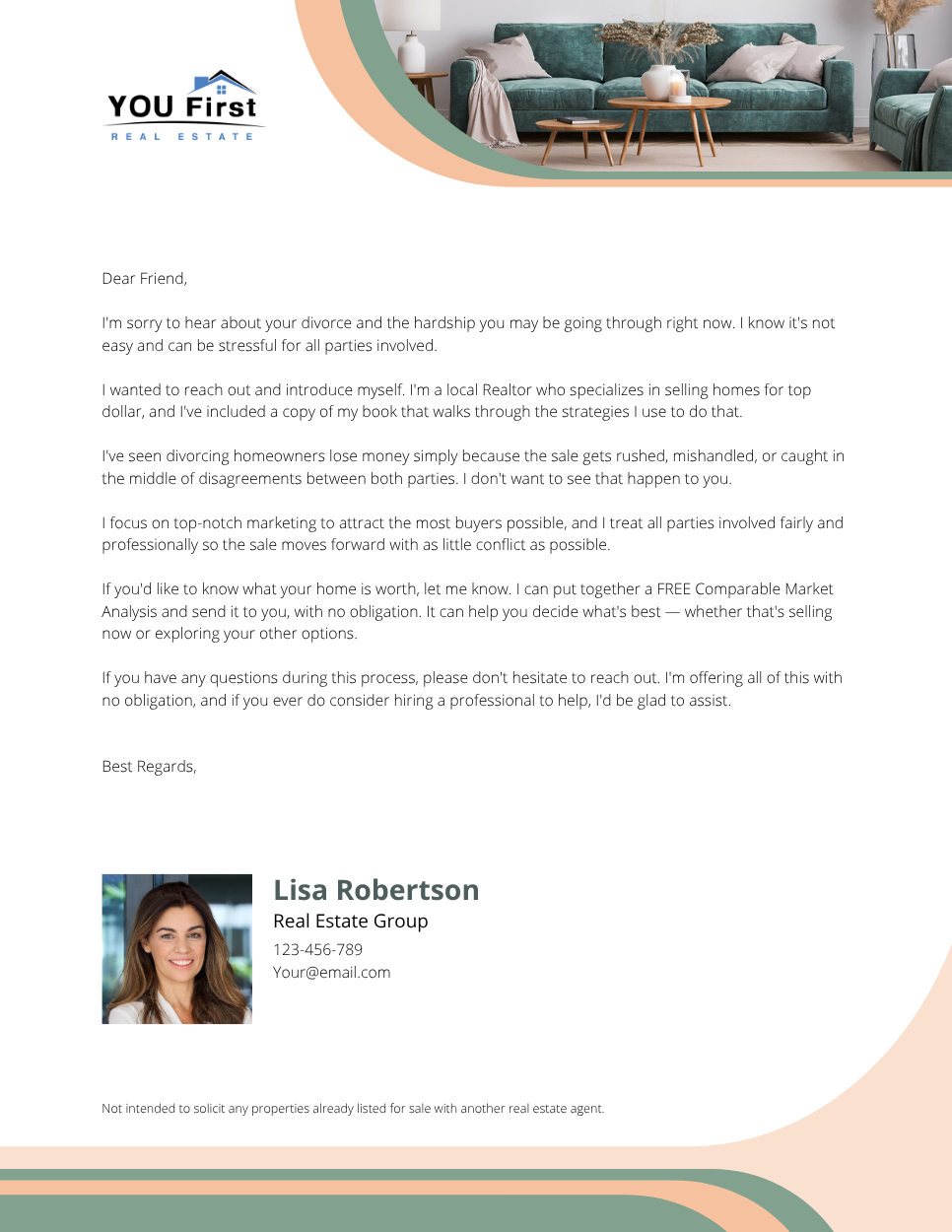
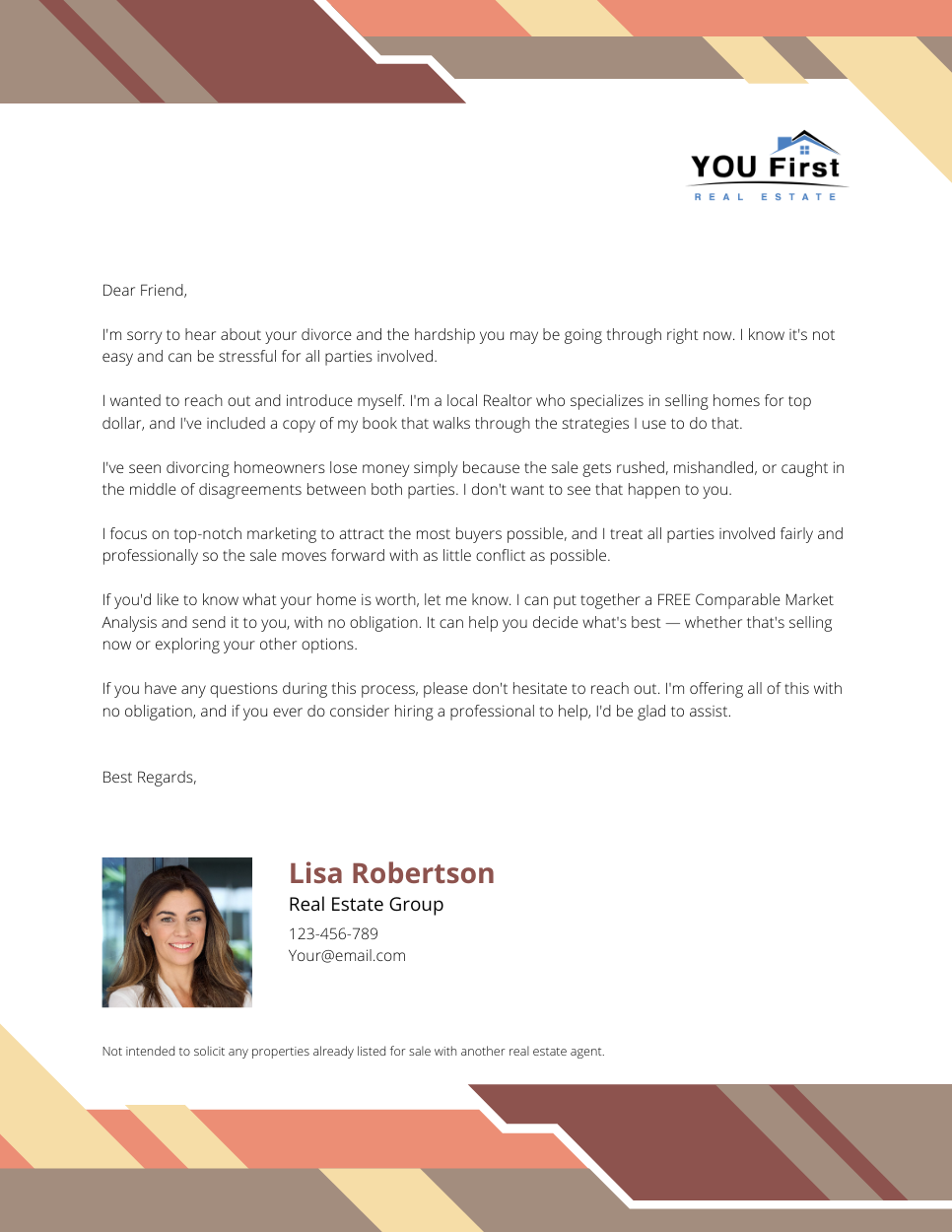
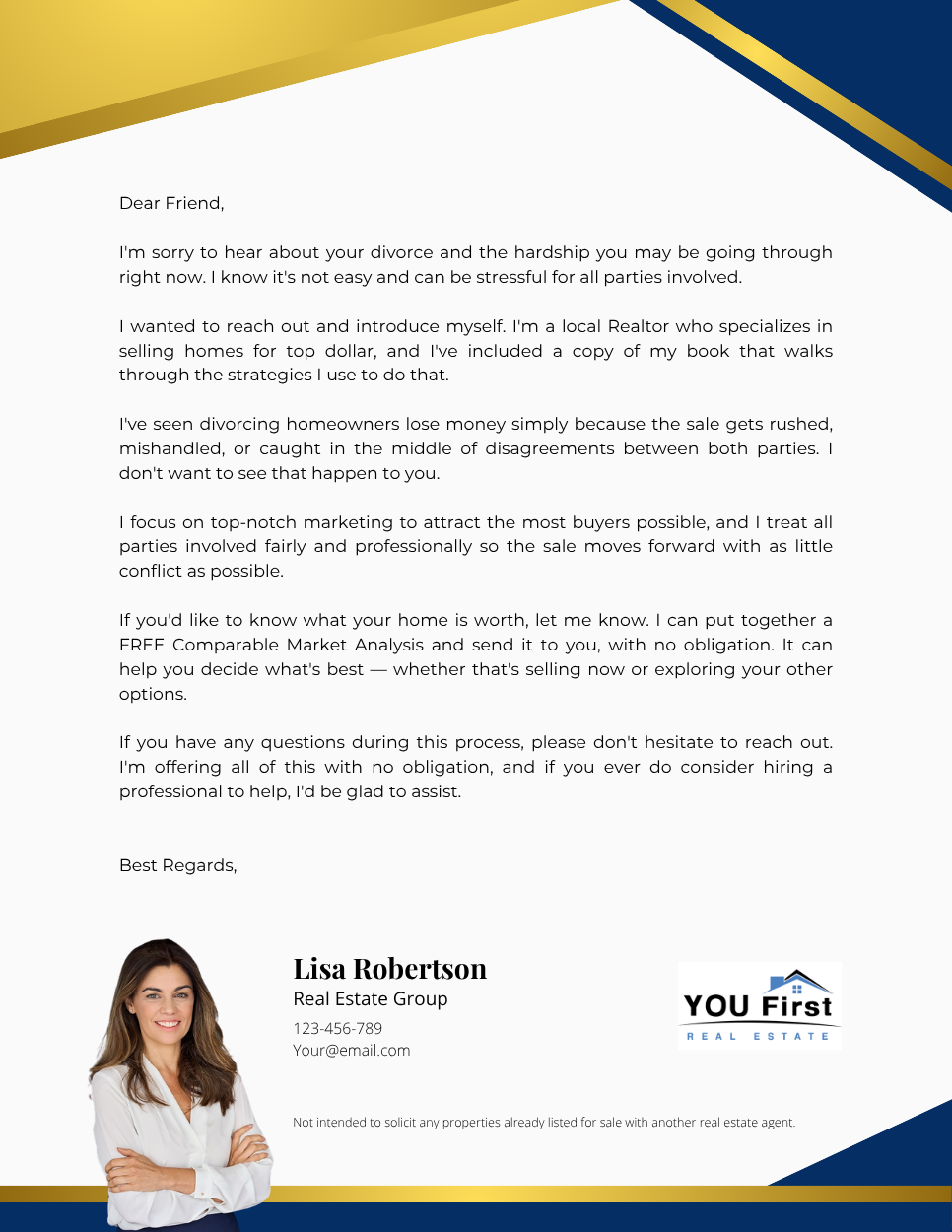
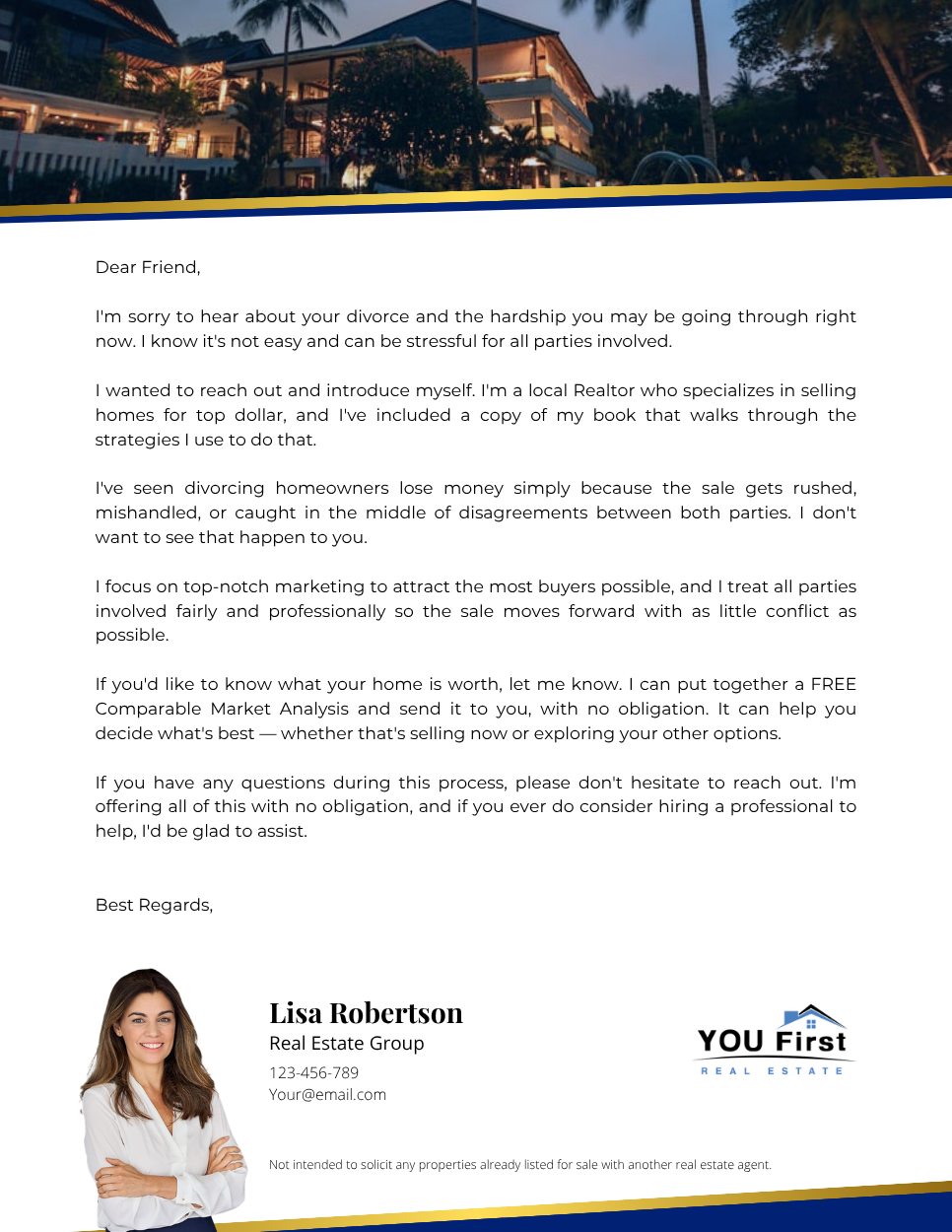
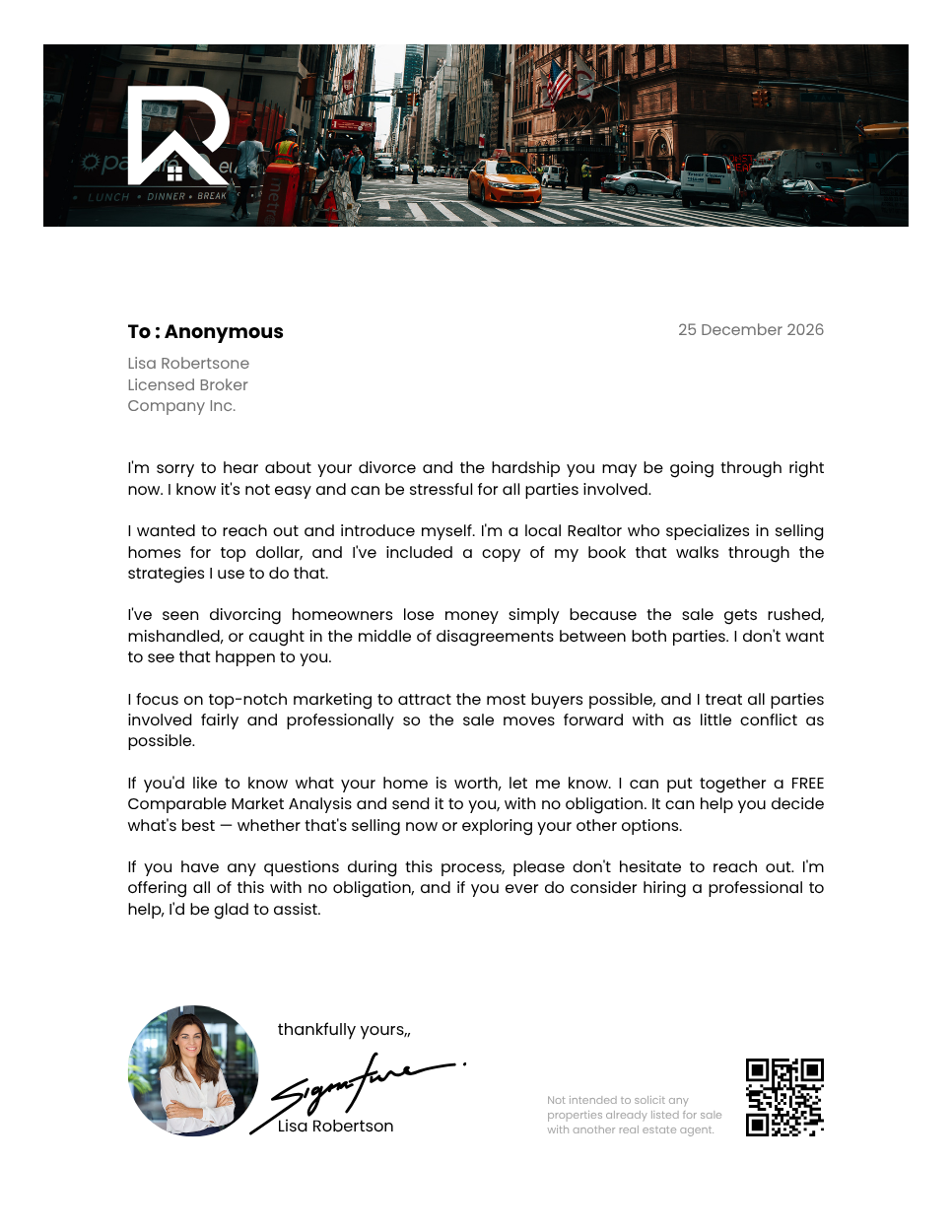
The cover letter introduces you and explains why you’re sending the book. Linked below are five variations of our Divorcing Homeowners cover letter.
Click the desired image to access the customizable Canva Template.
Watch the video below for customization tips.
Customization Checklist:
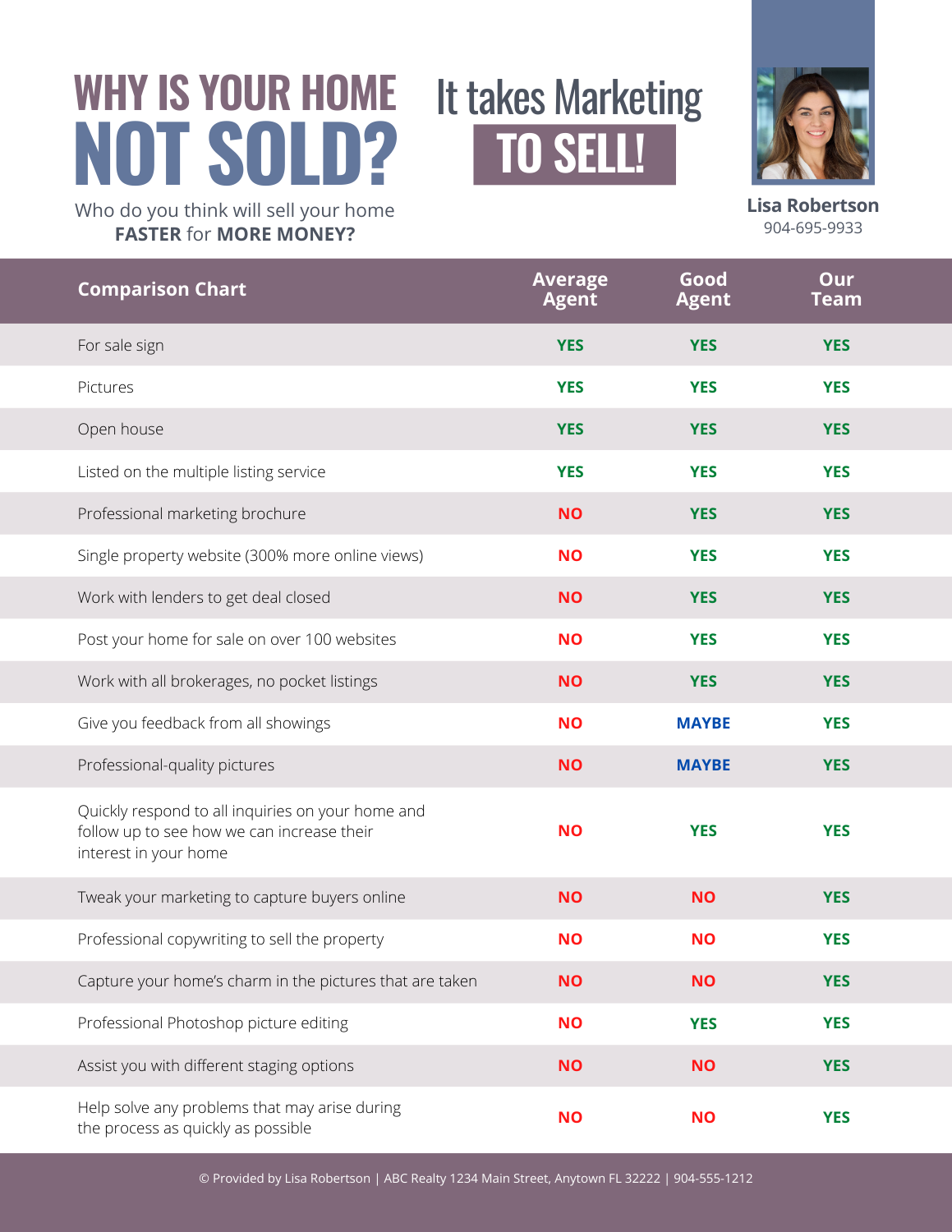
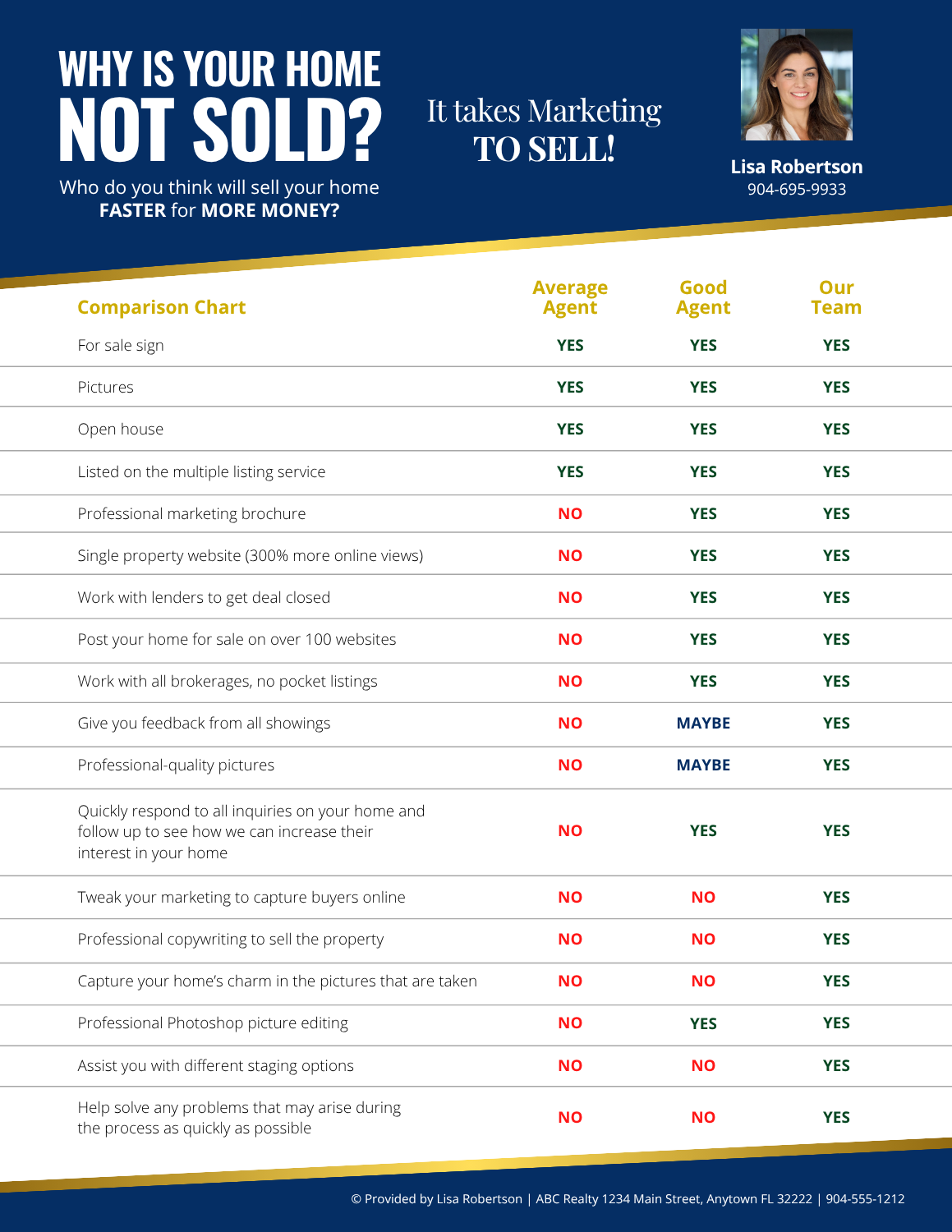
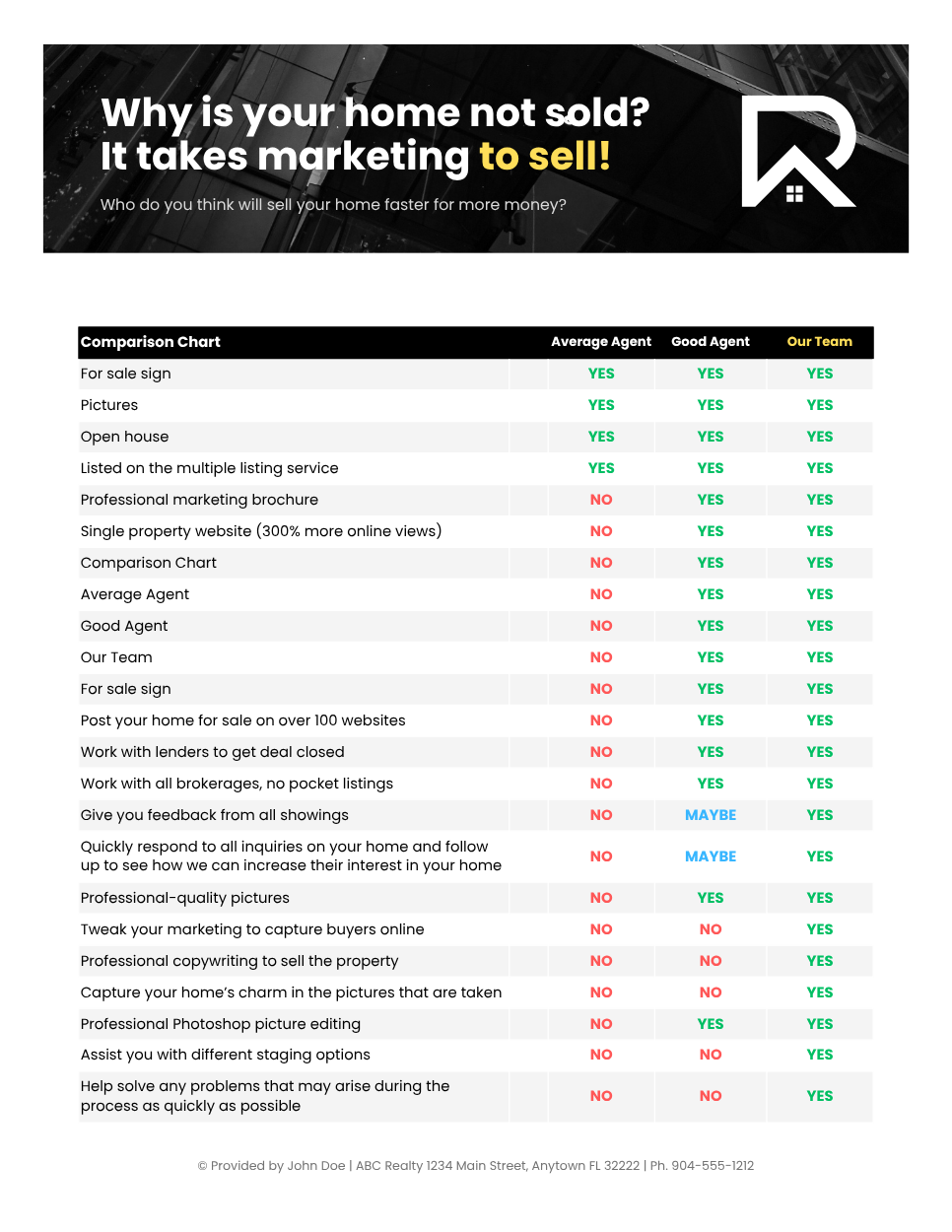
Use this chart to compare what you do to market a home versus what kind of service the average agent typically provides.
Click the desired image to access the customizable Canva Template.
Watch the video below for customization tips.
Customization Checklist:
Not interested in using the Canva Template?
Use this guide to share the importance of marketing and how you will help your clients listings stand out.
Click the desired image to access the customizable Canva Template.




Watch the video below for customization tips.
Customization Checklist:
Not interested in using the Canva Template?
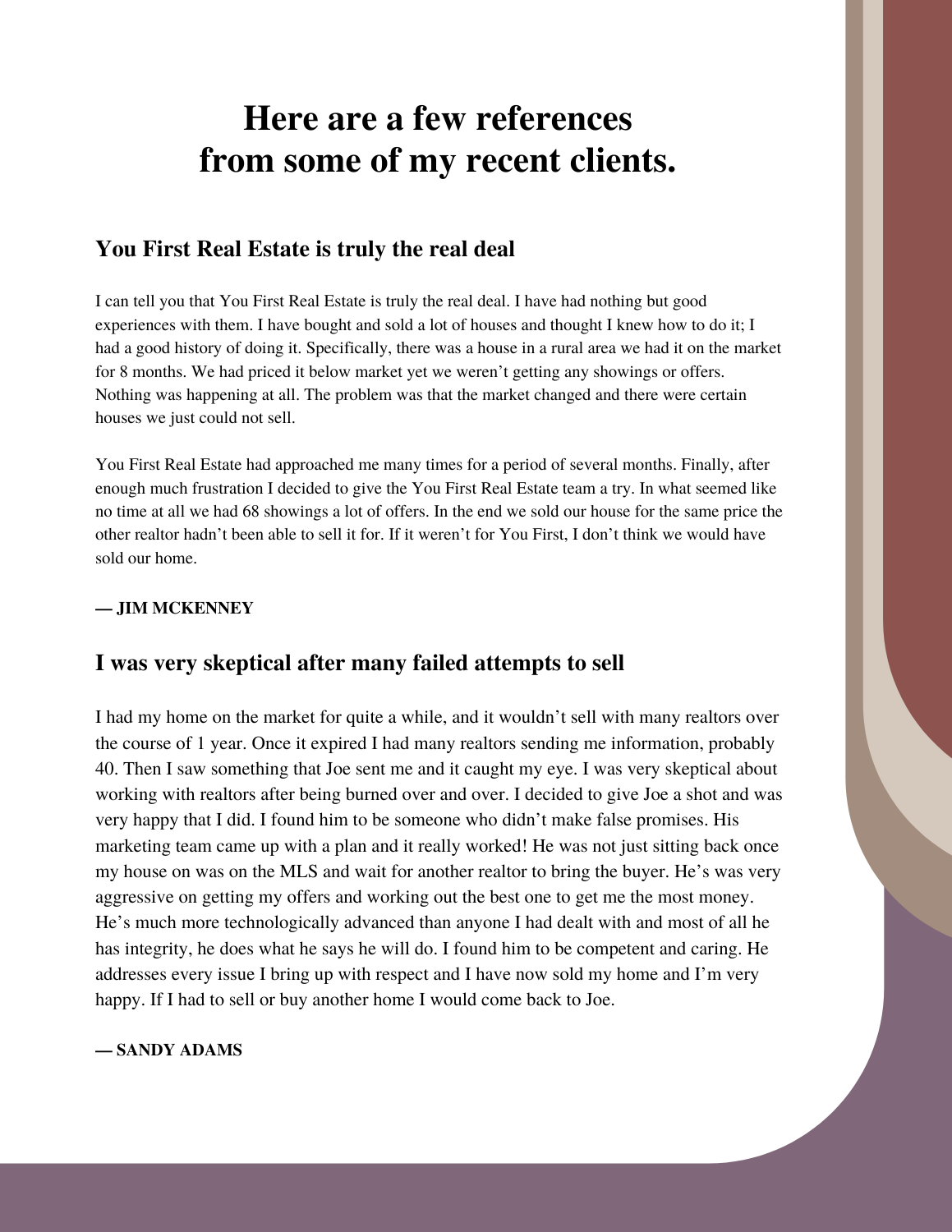
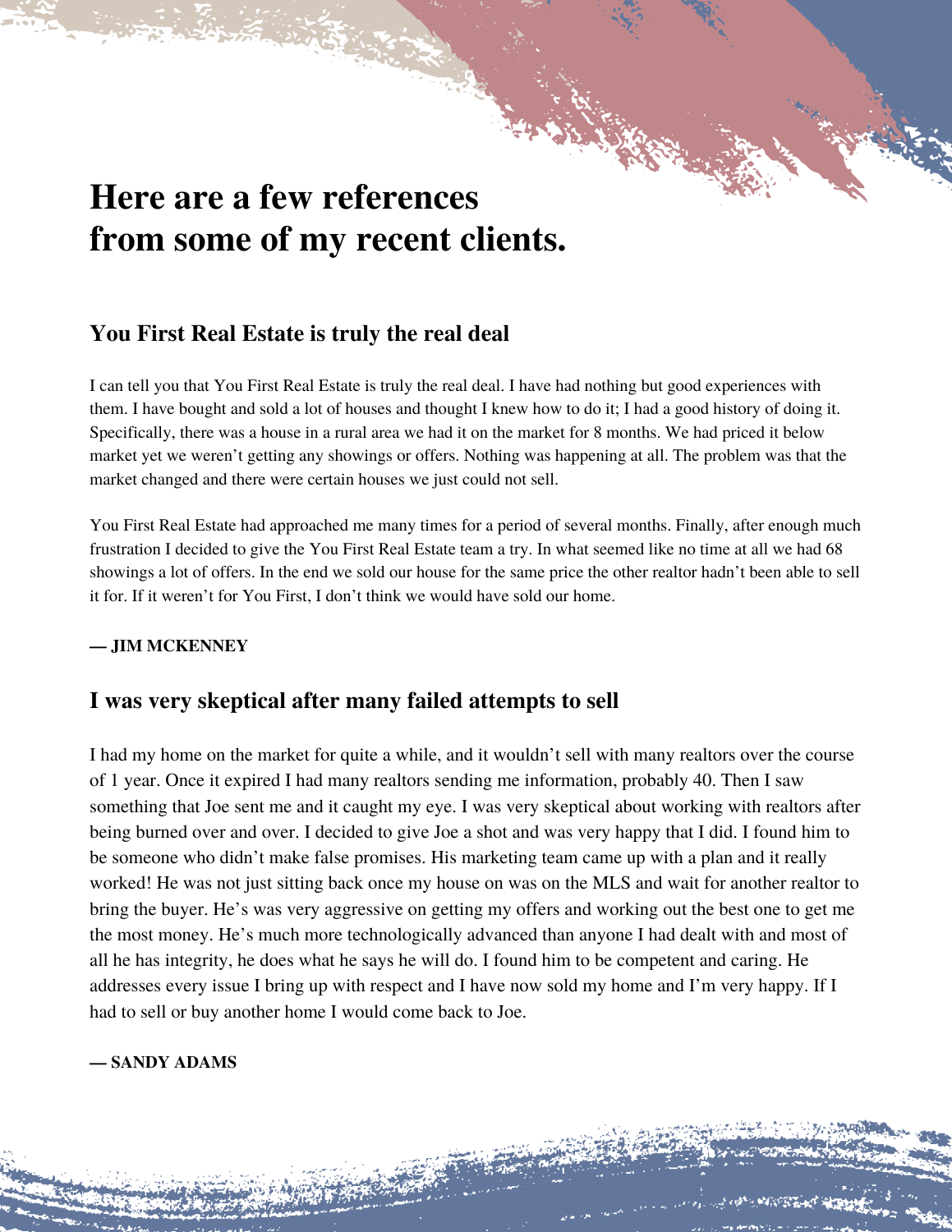
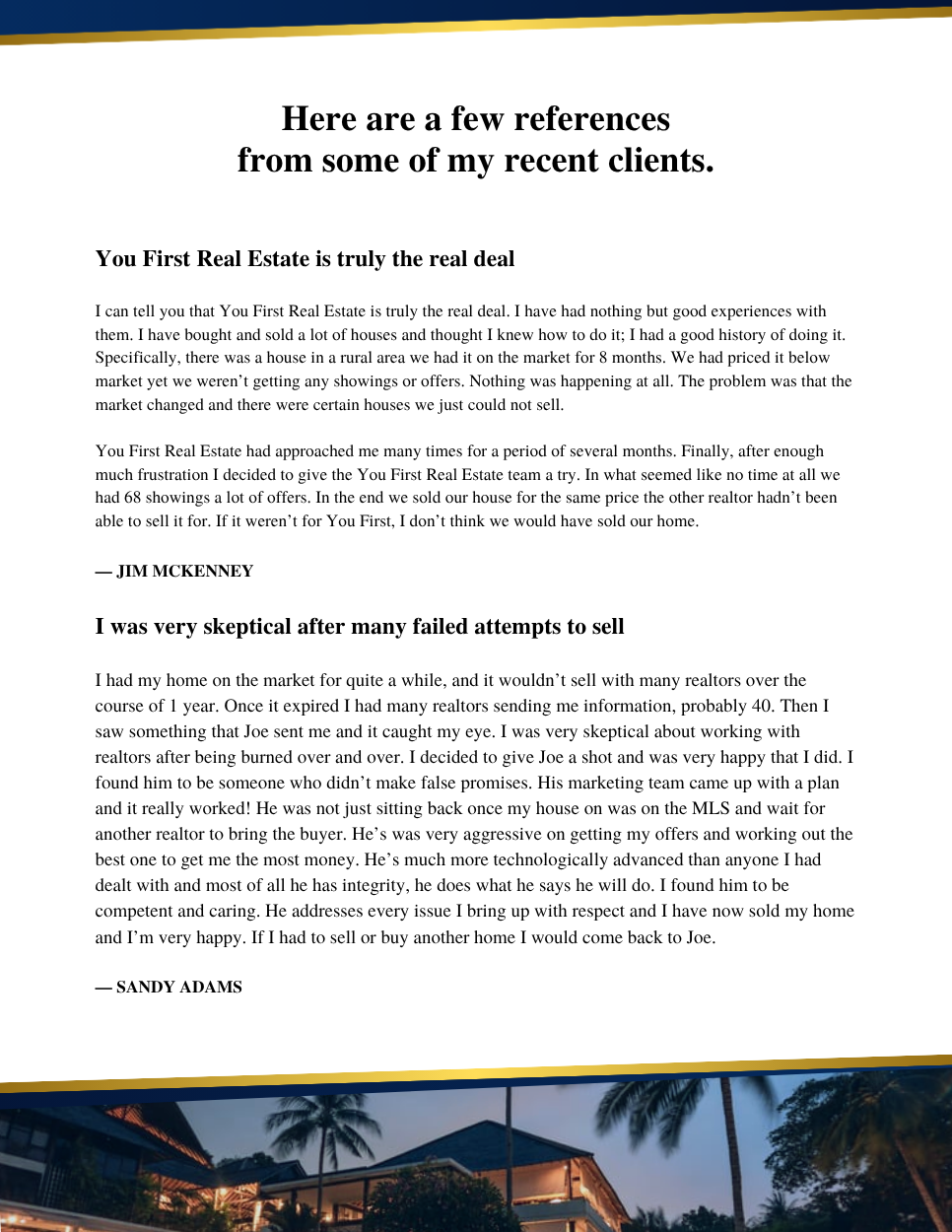
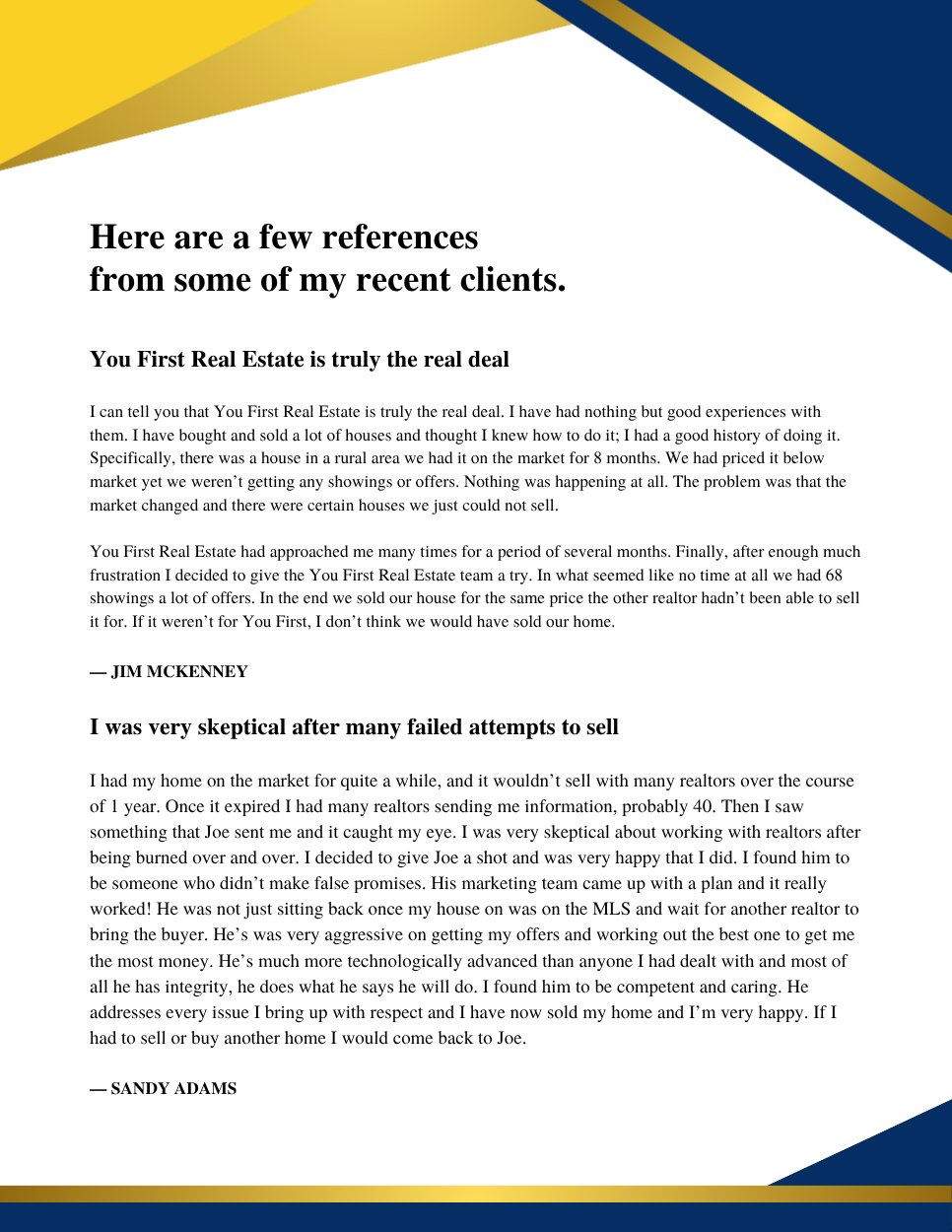
Add testimonials and references from customers and colleagues to this document.
Click the desired image to access the customizable Canva Template.
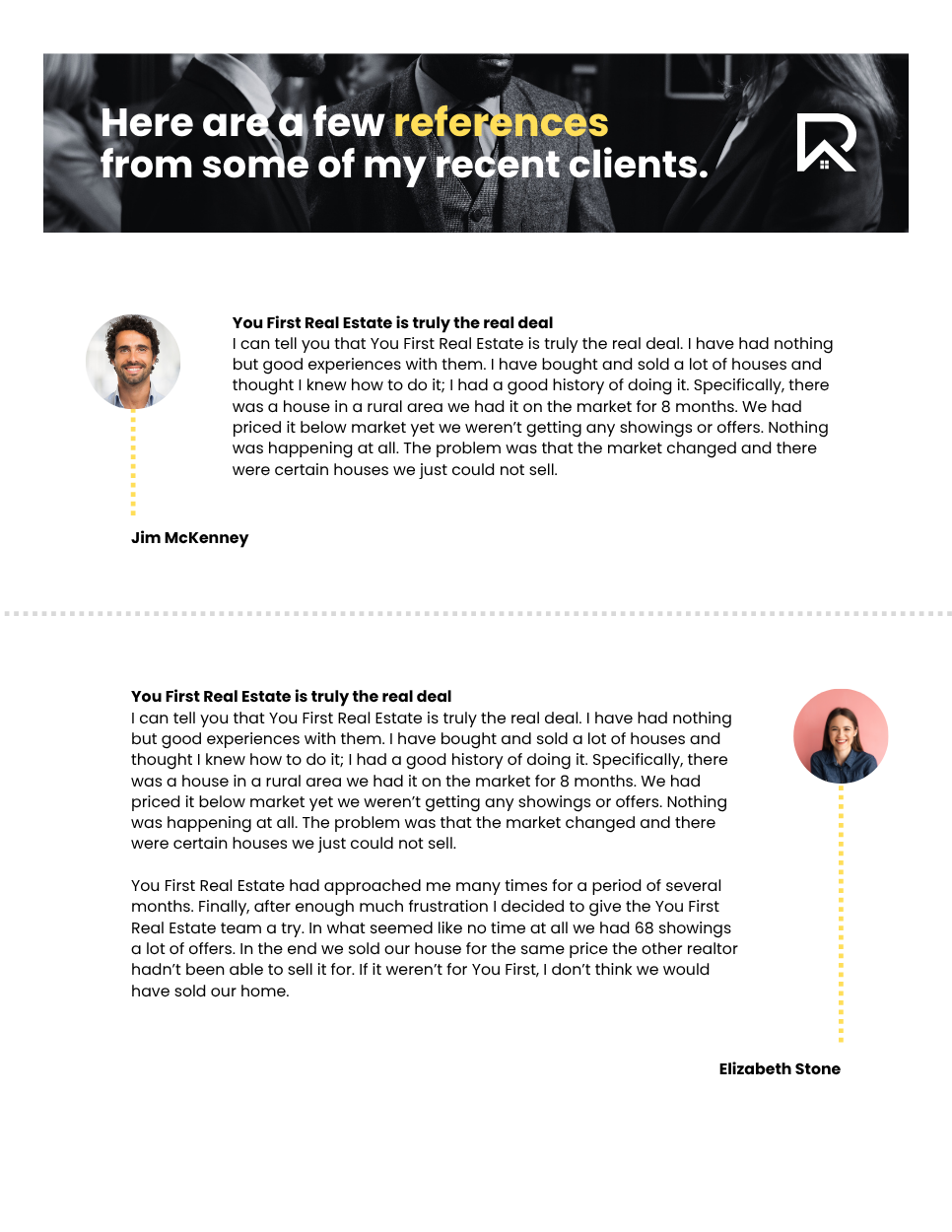
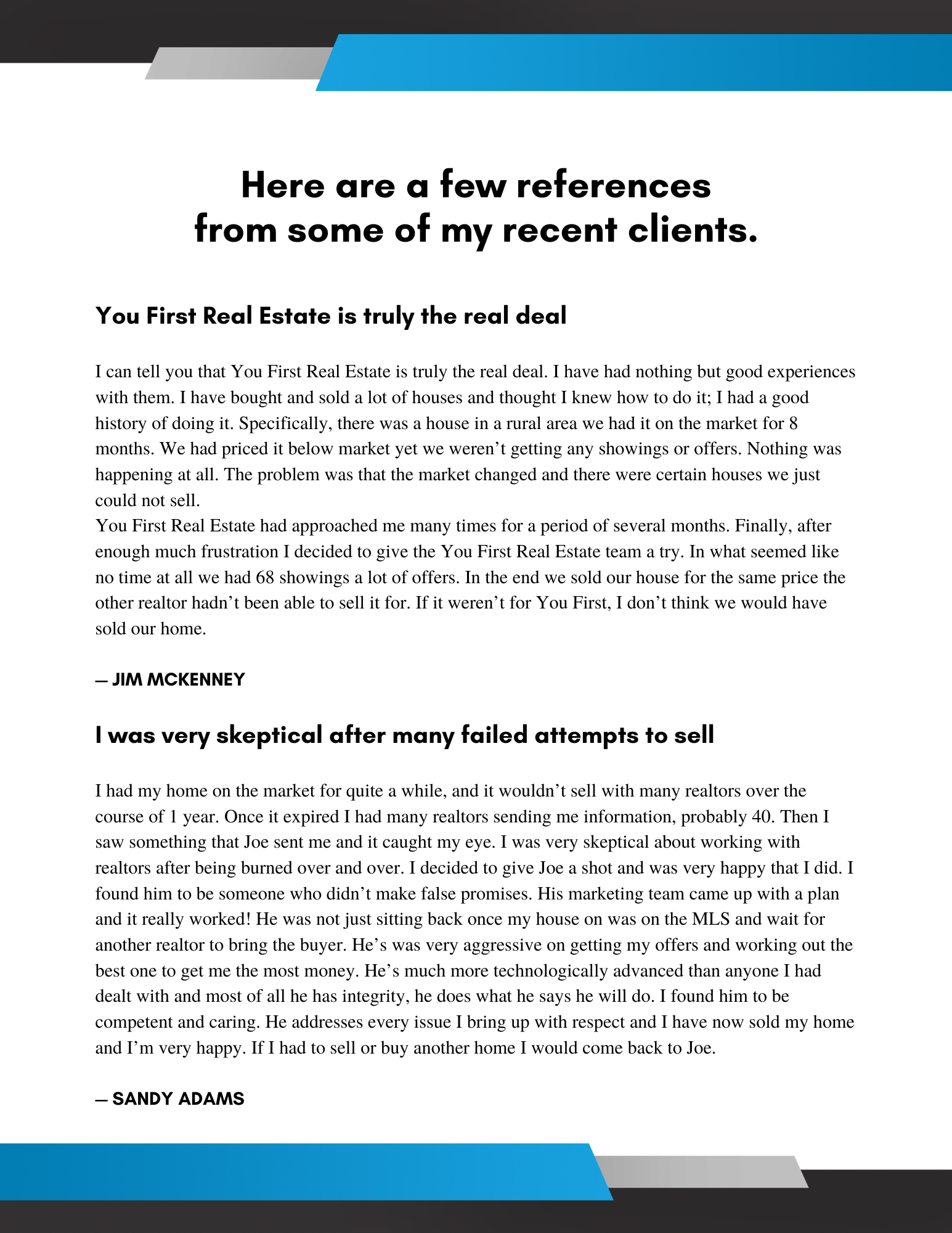
Watch the video below for customization tips.
Customization Checklist:
Not interested in using the Canva Template?
This will prove that you are going to advertise the home better than other agents.
Click the desired image to access the customizable Canva Template.
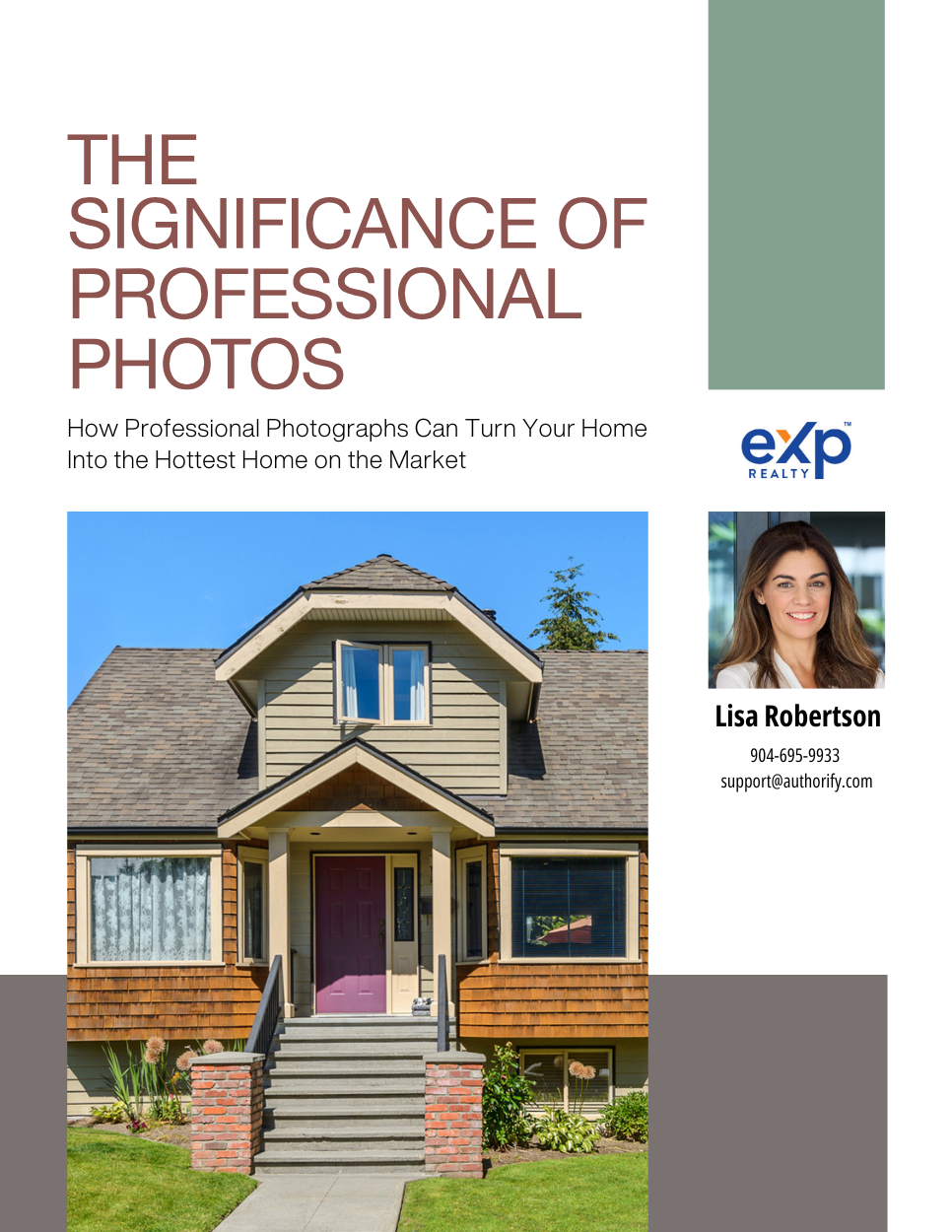




Watch the video below for customization tips.
Customization Checklist:
Not interested in using the Canva Template?
Dear Friend,
I'm sorry to hear about your divorce and the hardship you may be going through right now. I know it's not easy and can be stressful for all parties involved.
I wanted to reach out and introduce myself. I'm a local Realtor who specializes in selling homes for top dollar, and I've included a copy of my book that walks through the strategies I use to do that.
I've seen divorcing homeowners lose money simply because the sale gets rushed, mishandled, or caught in the middle of disagreements between both parties. I don't want to see that happen to you.
I focus on top-notch marketing to attract the most buyers possible, and I treat all parties involved fairly and professionally so the sale moves forward with as little conflict as possible.
If you'd like to know what your home is worth, let me know. I can put together a FREE Comparable Market Analysis and send it to you, with no obligation. It can help you decide what's best — whether that's selling now or exploring your other options.
If you have any questions during this process, please don't hesitate to reach out. I'm offering all of this with no obligation, and if you ever do consider hiring a professional to help, I'd be glad to assist.
Best Regards,
Your Name
Your Real Estate Company
Phone: (XXX)XXX-XXXX
Email: Name@Email.com
Not intended to solicit any properties already listed for sale with another real estate agent.
A Strong Marketing Plan Is The Key To Selling Your Home For Top Dollar
I mailed you a copy of my book that reveals how to sell a home for top dollar during a divorce. Make sure you check out all the useful tips inside.
My book has lots of helpful information on how to attract more buyers to your home.
Here are some of the best tidbits you’ll find inside:
- How you can use the 80/20 rule to make your home stand out from other homes and attract the ideal buyer. (These buyers are more likely to pay you top dollar for your home.)
- Why the pictures of your home are crucial to getting it sold.
- How to get top-notch pictures of your home so buyers fall in love with it and schedule a showing.
- Why the showing condition of your home is so important and can compel buyers to pay 5-10 percent more money for it.
- Several different ways you can improve the showing condition of your home so it sells for top dollar.
Would you like to know exactly how I can generate more buyer interest in your home and get it sold? Then give me a call at (XXX)XXX-XXXX to schedule a meeting. Or, send me an email at Name@Email.com. I look forward to hearing from you.
Sincerely,
Your Name
Your Real Estate Company
Phone: [XXX]XXX-XXXX
Email: Name@Email.com
Not intended to solicit any properties already listed for sale with a real estate agent. If your home is already for sale, then please disregard this message.
My 3-Step Formula Will Get Your Home Sold For Top Dollar!
I sent you my divorce home-selling book and haven’t heard back from you yet, so I’m following up.
Inside my book, I show you some of my different home-selling strategies that will get your home sold for top dollar.
The 3 most important tips are what I call the 3-Step Formula. I understand you may not have had the time to read my book. So…
Here’s a quick summary of the 3-Step Formula that will get you top dollar:
#1. Expose your home to more buyers. 93% of buyers start their searches online. I have access to extensive online marketing that will expose your home to the most buyers possible.
#2. Top-Notch Marketing. There are many different aspects of marketing. But, the most important ones are:
- High-quality, charming pictures that showcase your home’s appeal online.
- Understanding the 80/20 rule and using it to make your home stand out from other homes.
- The process I use to hook buyers online and cause them to fall in love with your home before they have ever seen it in person
#3. Help you improve the showing condition of your home. A staged home will sell for more money than a home that is not staged.
This is a brief letter, so I won’t write the contents of the entire book. But when you’re ready for more in-depth information, you can find it all inside my book. Or, you can give me a call at (XXX)XXX-XXXX. I’d be happy to meet with you and explain these strategies to you in person.
Sincerely,
Your Name
Your Real Estate Company
Phone: [XXX]XXX-XXXX
Email: Name@Email.com
Not intended to solicit any properties already listed for sale with a real estate agent. If your home is already for sale, then please disregard this message.
The Pictures Of Your Home Can “Make” Or “Break” Your Sale!
Let Me Help You “Make The Sale” And Get Your Home Sold!
Think about it. When you’re browsing online for your next home, what piques your interest?
Even if the square footage, neighborhood and everything else is perfect, if a house doesn’t look good in the photos, you probably won’t go see it in person.
It’s been proven that getting the best photos of your home will attract more buyers.
Here’s how I’ll capture top-notch pictures to use in marketing your home:
#1: Make sure the pictures are captured by a professional, experienced photographer that uses professional-grade equipment.
#2. Ensure that the pictures of your home capture its best features and the natural “charm” of your home. Great pictures are an art and a science. I’ll make sure they look amazing.
#3. Professional Photo Editing. An Instagram filter is not going to cut it! I’ll make sure the photos are touched up to make them look their absolute best.
Would you like to see exactly how attractive pictures will generate more buyer interest so you get top dollar? Then please give me a call at (XXX)XXX-XXXX to schedule a meeting. Or, send me an email at Name@Email.com.
Sincerely,
Your Name
Your Real Estate Company
Phone: [XXX]XXX-XXXX
Email: Name@Email.com
Not intended to solicit any properties already listed for sale with a real estate agent. If your home is already for sale, then please disregard this message.
Why You Should Consider Hiring Me To Sell Your Home
If you decide to sell your home, here’s why you should consider hiring me to help you. Your home deserves the attention that a top-notch marketer can give to it.
If you hire me to sell your home, I will implement my 10-step system to sell your home for the most money possible in the shortest amount of time.
Here’s my 10-Step Plan to market your home aggressively and get it sold:
Step 1: Evaluate your home to identify the reasons it may not have sold yet.
Step 2: Evaluate the price of your home in the current market, and tweak if necessary.
Step 3: Determine the best features of your home and aggressively market them to buyers.
Step 4: Identify any necessary repairs or upgrades to your home.
Step 5: Help you stage your home to highlight its beauty and functionality.
Step 6: Take professional photos that show your home’s exterior and interior to showcase your home in its best light.
Step 7: Use vivid language to create an online listing that attracts the right buyers to your home.
Step 8: Promote your home on a variety of real estate websites and social media platforms for maximum buyer exposure.
Step 9: Set up tours for interested buyers and get their feedback afterward.
Step 10: Negotiate the highest possible price to sell in a timely fashion that suits you, as well as the buyer.
Would you like to see exactly how attractive pictures will generate more buyer interest so you get top dollar? Then please give me a call at (XXX)XXX-XXXX to schedule a meeting. Or, send me an email at Name@Email.com.
Sincerely,
Your Name
Your Real Estate Company
Phone: [XXX]XXX-XXXX
Email: Name@Email.com
Not intended to solicit any properties already listed for sale with a real estate agent. If your home is already for sale, then please disregard this message.
Step 1: Make sure you are talking to the right person. That’s why you want to call and ask for the owner by their first name only.
“Hi, is this [First Name]?”
Step 2: Introduce yourself and try to start a conversation.
“Hey [name of prospect]! This is [Your Name]. I’m a Realtor, and I sent you a copy of my home-selling book that has some tips about selling your home during a divorce. Do you remember seeing that book?”
Pause and wait for them to answer.
“Here’s something that might be helpful for you. A lot of people in your situation want to get a Market Analysis to see exactly what their home is worth. This helps them make a better decision on what to do during the process. I can put together a free, complimentary market analysis for you. Is that something you’d be interested in?”
Pause and wait for them to answer.
If they say “Yes,” ask for information on their home and — if possible — set up an appointment to meet them and check out their home.
If they say “No,” ask them the following:
“I specialize in selling homes for people going through a divorce. I’d like to have a chance to show you and your soon-to-be ex-spouse how I can help you with that. Would you give me the opportunity to do that if you do decide to sell your home?”
If they say “No,” thank them for their time and end the call.
If they say “Yes,” ask them the following:
“At this point, do you think you will be selling or are you leaning toward one of you keeping the home and buying the other one out?”
If they say “Selling,” then ask them the following:
“If that is the case, the next step would be for me to check out the house and give you an idea of what I think I can sell it for. When is a good time that I can meet with you to check out the house?”
If possible, try and meet with both parties together. If not, you need to meet with one, do a CMA, give them your listing presentation, and try to win them over. After that, you need to meet with the other party, and go through the entire process with them, as well.
If you do a good job at this, then you can win over both parties and win the listing. It’s actually not that hard to be the winning “neutral” agent. Here’s why. Most of the time, if one party brings in their preferred agent, the other one will naturally distrust that “preferred” agent because they feel like they’ll represent the other party at their expense.
So, unless both parties have a “neutral” agent that they like and trust — which is rare — then it’s easy for you to be that “neutral” agent and win the listing.
If they say “One of us will be keeping the home,” then ask them the following:
“Ok. Thank you for your time. If you don’t mind, I might check back with you down the road in case anything changes.”
Thank them for their time and end the call.
Note. It pays to follow up even if they are certain that the other party will be buying them out. Oftentimes, one party thinks they have the financial capability to buy out the other party. But, those deals often fall through because of a disagreement over the home’s value or because the other party can’t obtain financing.
Template Directions: Send one of the templates below to homeowners going through a divorce. Simply fill in your own information in the email signature, and put the person’s name where it says HOMEOWNER.
Subject Lines:
I know you’re going through a hard time…
Let me help you through this tough time
Don’t know where to turn?
Selling your home doesn’t need to be stressful
Body Text:
HOMEOWNER,
I have helped many divorcing homeowners navigate the sale of their previous homes.
Approaching a home sale after divorce can be stressful — and cause a lot of unnecessary headaches. I’m fully equipped to help you through this process as seamlessly and successfully as possible.
Would you consider selling your home if you could get the right price? If you answered “Yes,” I’d love to sit down and talk with you about the plan I’ve come up with to sell your home for the greatest amount of money in the least amount of time.
I’m very familiar with your area and know I can sell your house just by getting the right buyers in the door.
Will you take a leap of faith with me?
Your Name
Your Real Estate Company
Phone: (XXX)XXX-XXXX
Email: Name@Email.com